2nd Sunday after Pentecost – June 7th, 2026
Matthew 9: 9-13, 18-26
(Mercy not Sacrifice)
In our gospel reading today we have not one, but three different stories. The call of Matthew; the healing of the synagogue leaders daughter, and the woman with the haemorrhaging, who came up to Jesus from behind, touching his robe and was healed. We could take either one of these stories and have plenty to say about it; but because they are told together as they are I believe that is the way we are meant to look at them for Jesus is wanting us to hear.
Jesus calls Matthew to follow him; Matthew was a tax collector, and perhaps an unlikely prospect one would think for discipleship. His occupation alone would have deemed him unfit, in that the tax collectors were collaborators with the Romans, collecting taxes for the empire but known also for charging in excess of what was required of them, in order to benefit themselves; so would have been looked on unfavourably in the community, despised even. Jesus in calling Matthew was not only showing him to be acceptable, but was acting in opposition to moral and societal expectations & law of that day.
The Pharisees complain when they see Jesus eating with tax collectors and sinners; they don’t like this because it goes against what they deemed to be acceptable according to the religious traditions and laws they have put in place. Jesus however rebukes them saying, “those who are well have no need of a physician but those who are sick.” (Matt 9:12)
In a society that puts much emphasis on holistic wellness, we know there are far more damaging things that can cause one to be sick or unwell then what is visible to the eye; and Jesus was wanting the Pharisees to recognize that it is not only those deemed acceptable as such, by law that God’s mercy was intended for, but it was intended for all; including the tax collector and sinner or any who otherwise might be deemed unacceptable to others, including those in our own day.
So we too should consider how it is that we might deem some more acceptable of mercy than others, simply because of who they are, what they do, or even how they might be viewed because of their life or occupation they keep. Might God be calling you to see and show mercy to someone, you might otherwise dismiss, or overlook today.
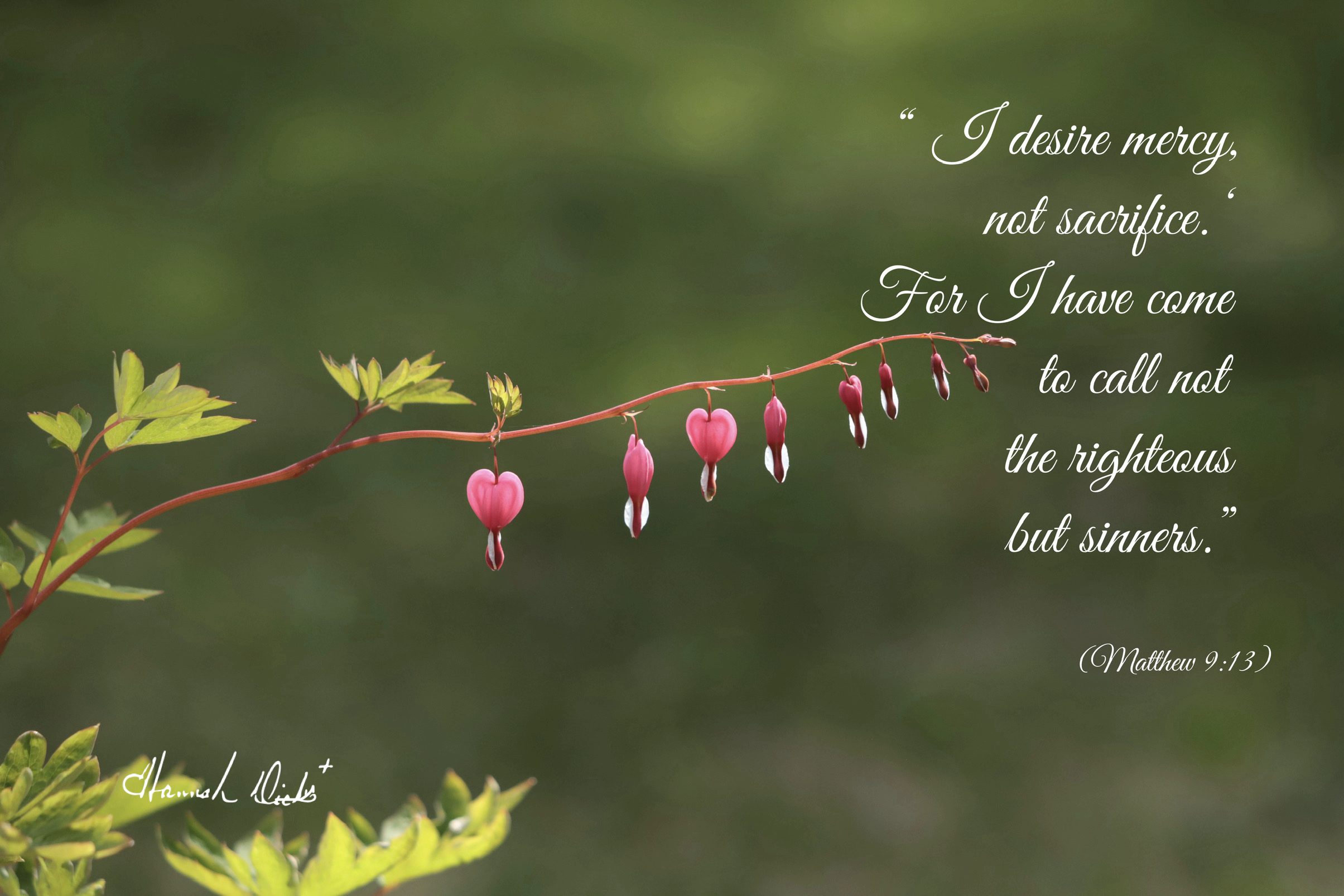
Jesus speaking to those complaining quoting from Hosea 6:6 of the old testament says, “Go and learn, what this means, I desire mercy, not sacrifice, for I have come to call not the righteous but sinners”. (Matt 9:13) The Pharisees showed great observance of the religious law and social order, but when it came to showing God’s mercy for others, they didn’t do right by it.
The gospel continues here with the story of ‘ the synagogue leader coming to Jesus for healing for his daughter, intertwined with the story of the woman with the haemorrhaging; both are stories of great desperation and need; Jesus doesn’t acknowledge ones’ need and not the other, but tends to both. And does so in a way that doesn’t set one apart as more important or of a greater priority then the other, treating both the same, given attention as needed.
The synagogue leader though he had likely followed and practiced all the religious laws faithfully, it however didn’t make him anymore deserving of God’s mercy than the woman with the heamorraging; she because of her condition was classed by the law as unclean; and would be prevented from coming to Jesus; while the synagogue leader had status and influence in the community to help him see Jesus, the woman had nothing, she however took great chance in coming to Jesus; they both crossed the religious law and boundaries in doing so; according to the levitical purity law it was unsafe for her to be around people, she not only chanced contaminating Jesus but those in the crowd; should she have been found out before getting to Jesus it would likely have been great consequences for her; the synagogue leader, likly previously had been with those who showed opposition to Jesus, he not only showed he believed in Jesus, but kneeling before Jesus has he did, something no one his status would ever do in public, he showed his willingness to cast aside the social and religious boundaries and barriers that would have kept in from Jesus.
Jesus sees them both not separately according to status, or place in the community, but both the same; even though he stops on the way to the synagogue leaders house for the woman to receive healing, ….it doesn’t mean he makes her a greater priority over the other, but simply it was the need that was before him in that moment, and that’s what he attended to.
If only we were so observant of those who come to us, unexpectedly, those we cross paths with in the normal routine of our daily lives, seeing them in the way that Jesus sees her. Not as one to be dismissed, or overlooked, but that she too was worthy of being seen.
Jesus doesn’t just see only the need that he is presented with, but sees the whole person.
“Take heart, daughter, he says, your faith has made you well.” (Matt 9:22)
Can you imagine what that did for this woman, someone who had been not only physically ill, but deemed socially unacceptable, morally and ritually unclean for all of these twelve years; Jesus not only healed the physical problem of her haemorrhaging, but also recognized all the mental and social desolation this woman would have endured for these years. Addressing her as daughter, he shows her belonging, gives her value, and worth.
And that too is too is how we are to be with others; regardless of the need or who they are, showing the same mercy as Jesus did, we give dignity and worth to all. All too often its the need that is tended to, and not the person that is there. It’s being present in the moment with the person as much as the need we tend to, that we help effect healing in a way that matters. “I desire Mercy, Jesus says, not Sacrifice.”
The world needs to work greatly on the mercy it gives.
Coming to the synagogue leaders house, hearing the flutes playing, and the commotion of the crowd, Jesus says, “Go away, for the girl is not dead but sleeping.” (9:24) Jesus had not come to partake in a funeral ritual but to restore life. These people were mourning her death, they thought it pointless likely that he had come. They laugh at him. Jesus puts them outside, and when he went in he took the little girl by the hand and she got up. And the report of it spread throughout the district. (9:25) “I desire Mercy, Jesus says, not Sacrifice” (9:13).
We sometimes perhaps can’t imagine Mercy being effective, any more than these people did, especially in the world we live today, with its many needs requiring so much of us; where do we begin, how can we make a difference, what can we do;
we know however it is only in acting in merciful ways, showing great kindness, responding in loving action toward others, doing all the good that we can, in whatever way that we can, that we too will help heal some of the much brokenness that exists in peoples lives and in the world today.
We can’t do that by turning away, or pretending its not there; but by being present and that perhaps is the most merciful thing we can do sometimes, is not always the big things, or how much we might do, but sometimes it is just to be present; present to the other, so that Mercy is felt, seen and known. “I desire Mercy, Jesus says, not sacrifice.”
May we always be a merciful people, revealing God’s own love, mercy, and acceptance, to all in our world today. “I desire Mercy Jesus says, not Sacrifice.” (9:13)
Amen, God Bless
Hannah+.


3 responses to “Mercy not Sacrifice”
Beautiful sermon, Jesus looks at all of us in the same way, no one is greater than the other, we are all equal in His eyes🙏
LikeLiked by 1 person
Very well written Rev. Hannah. I did the service at St. James, Carbonear , yesterday. Rev. Maxine is on vacation, my thoughts were similar to yours.
LikeLiked by 1 person
Thank you for your comment, appreciate hearing from you, God Bless.
LikeLike